
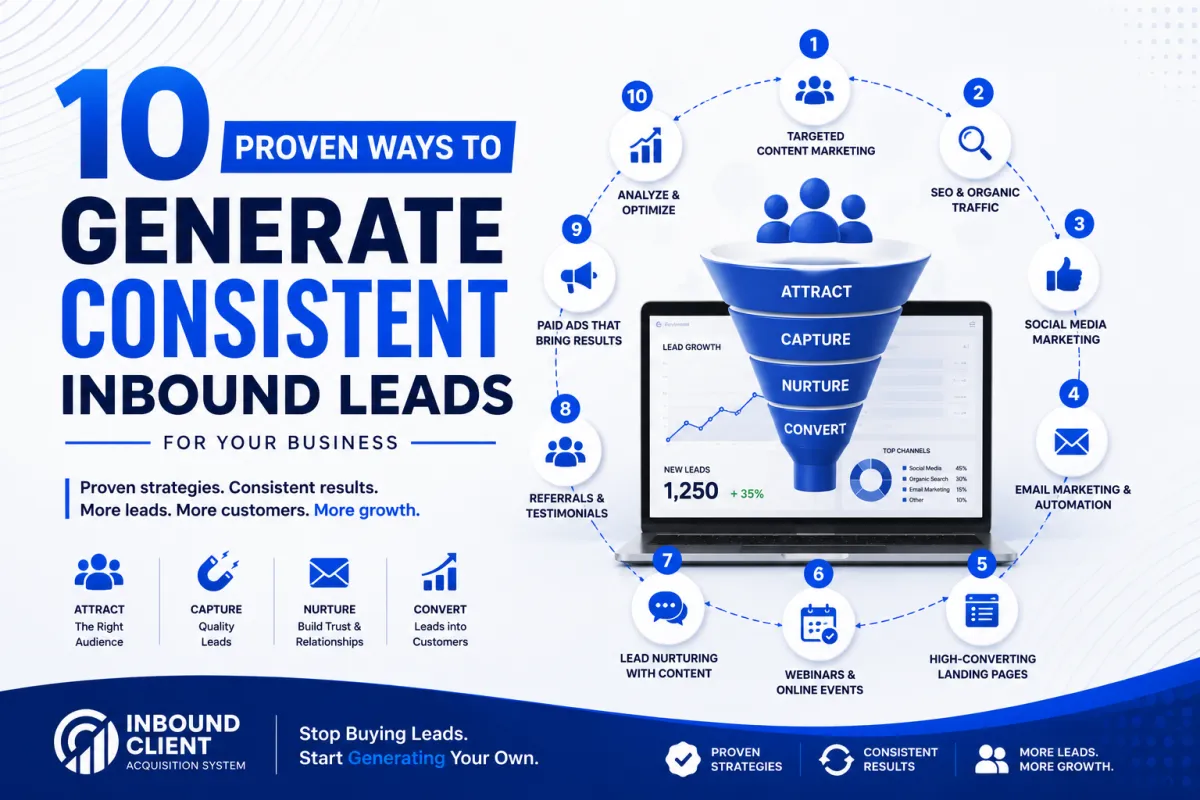
10 Proven Ways to Generate Consistent Inbound Leads for Your Business
Generating inbound leads is one of the biggest priorities for businesses looking to grow sustainably. Unlike outbound marketing, where companies actively reach out to potential customers, inbound marketing focuses on attracting qualified prospects who are already searching for solutions. These prospects are more likely to engage, convert, and become long term customers because they have shown genuine interest in your products or services.
However, consistent lead generation does not happen by chance. It requires the right strategy, valuable content, and an optimized digital presence. If your business wants to build a predictable pipeline of high quality leads, here are ten proven methods that deliver measurable results.
1. Understand Your Ideal Customer
Every successful inbound marketing strategy starts with knowing exactly who you want to attract. Create detailed buyer personas based on your target audience's industry, job role, business challenges, goals, and buying behavior.
When you understand what your potential customers are looking for, you can create content and marketing campaigns that directly address their needs. This increases engagement and improves conversion rates.
2. Invest in High Quality Content Marketing
Content remains one of the strongest drivers of inbound leads. Businesses actively search online for answers before making purchasing decisions. Publishing valuable content positions your company as a trusted authority.
Focus on creating blog articles, industry insights, case studies, whitepapers, guides, and practical resources that solve real business problems. Educational content builds trust and keeps your brand visible throughout the buyer's journey.
Consistency matters more than volume. Publishing helpful content regularly creates long term organic traffic that continues generating leads over time.
3. Optimize Your Website for Search Engines
Search Engine Optimization plays a vital role in attracting inbound traffic. Even the best content cannot generate leads if it does not appear in search results.
Research relevant keywords your target audience is searching for and naturally incorporate them into page titles, headings, meta descriptions, and website content. Ensure your website loads quickly, works well on mobile devices, and provides an excellent user experience.
Strong SEO allows potential customers to discover your business when they are actively looking for solutions.
4. Create Valuable Lead Magnets
Many visitors are not ready to speak with a sales team during their first visit. Offering valuable downloadable resources encourages them to share their contact information.
Effective lead magnets include:
Industry reports
Checklists
Templates
Ebooks
Business guides
The more relevant your resource is to your audience's challenges, the higher your conversion rate will be.
5. Build Landing Pages That Convert
A dedicated landing page performs much better than sending visitors to a general website page.
Every landing page should focus on one specific offer with a clear headline, concise benefits, and a simple form. Remove unnecessary distractions and make it obvious what visitors will receive after submitting their information.
Small improvements in landing page design can significantly increase lead generation.
6. Use Email Marketing to Nurture Prospects
Generating a lead is only the beginning. Many buyers require multiple interactions before making a purchasing decision.
Email marketing allows you to stay connected with prospects by sharing educational content, industry updates, product information, and success stories. Personalized email campaigns help move leads through the sales funnel while building trust over time.
Well planned email nurturing often results in higher conversion rates and stronger customer relationships.
7. Leverage Social Media for Thought Leadership
Social media is more than just brand awareness. It is an excellent platform for sharing expertise and engaging with decision makers.
Publish informative posts, industry insights, customer success stories, and valuable content that encourages conversations. Participate in relevant discussions and respond to comments to demonstrate credibility.
An active social presence increases visibility and drives qualified traffic back to your website.
8. Showcase Customer Success Stories
Trust is one of the biggest factors influencing purchasing decisions. Prospective customers want evidence that your solutions deliver results.
Share case studies, client testimonials, measurable outcomes, and real world examples that demonstrate your expertise. Highlight specific business challenges, the solutions you provided, and the results achieved.
Social proof helps reduce uncertainty and encourages potential customers to take the next step.
9. Improve Calls to Action Across Your Website
Visitors often leave websites simply because they are unsure what to do next.
Every important page should include a clear call to action that guides users toward the next step. Whether it is requesting a consultation, downloading a resource, scheduling a demo, or contacting your team, the message should be simple and compelling.
Strategically placed calls to action improve conversions without disrupting the user experience.
10. Measure, Analyze, and Continuously Improve
Successful inbound lead generation is an ongoing process rather than a one time effort.
Monitor key performance indicators such as website traffic, conversion rates, keyword rankings, lead quality, and customer acquisition costs. Analyze which channels generate the highest quality leads and identify opportunities for improvement.
Regular optimization ensures your marketing strategy continues delivering consistent results as customer behavior evolves.
Final Thoughts
Generating consistent inbound leads requires a combination of strategic planning, valuable content, search engine optimization, and continuous improvement. Businesses that focus on solving customer problems while creating a seamless online experience are more likely to attract qualified prospects and convert them into loyal clients.
Rather than relying on short term marketing tactics, invest in long term inbound strategies that build authority, trust, and sustainable business growth. Over time, these efforts create a reliable stream of high quality leads that support your sales pipeline and strengthen your competitive position.
Frequently Asked Questions
1. What are inbound leads?
Inbound leads are potential customers who discover your business through channels such as search engines, blogs, social media, or valuable content and voluntarily express interest in your products or services.
2. How long does it take to generate inbound leads?
Results vary depending on your industry and strategy. Businesses investing in SEO and content marketing often begin seeing meaningful improvements within three to six months, with stronger long term growth over time.
3. Which marketing channel generates the best inbound leads?
There is no single best channel. A combination of search engine optimization, content marketing, email marketing, and social media typically produces the strongest and most consistent inbound lead generation results.
4. Why is inbound marketing better for businesses?
Inbound marketing attracts decision makers who are actively researching solutions. This results in more qualified leads, shorter sales conversations, stronger customer relationships, and a higher return on marketing investment compared to many traditional outbound approaches.