Customer Acquisition Economics for Life Insurance Agencies
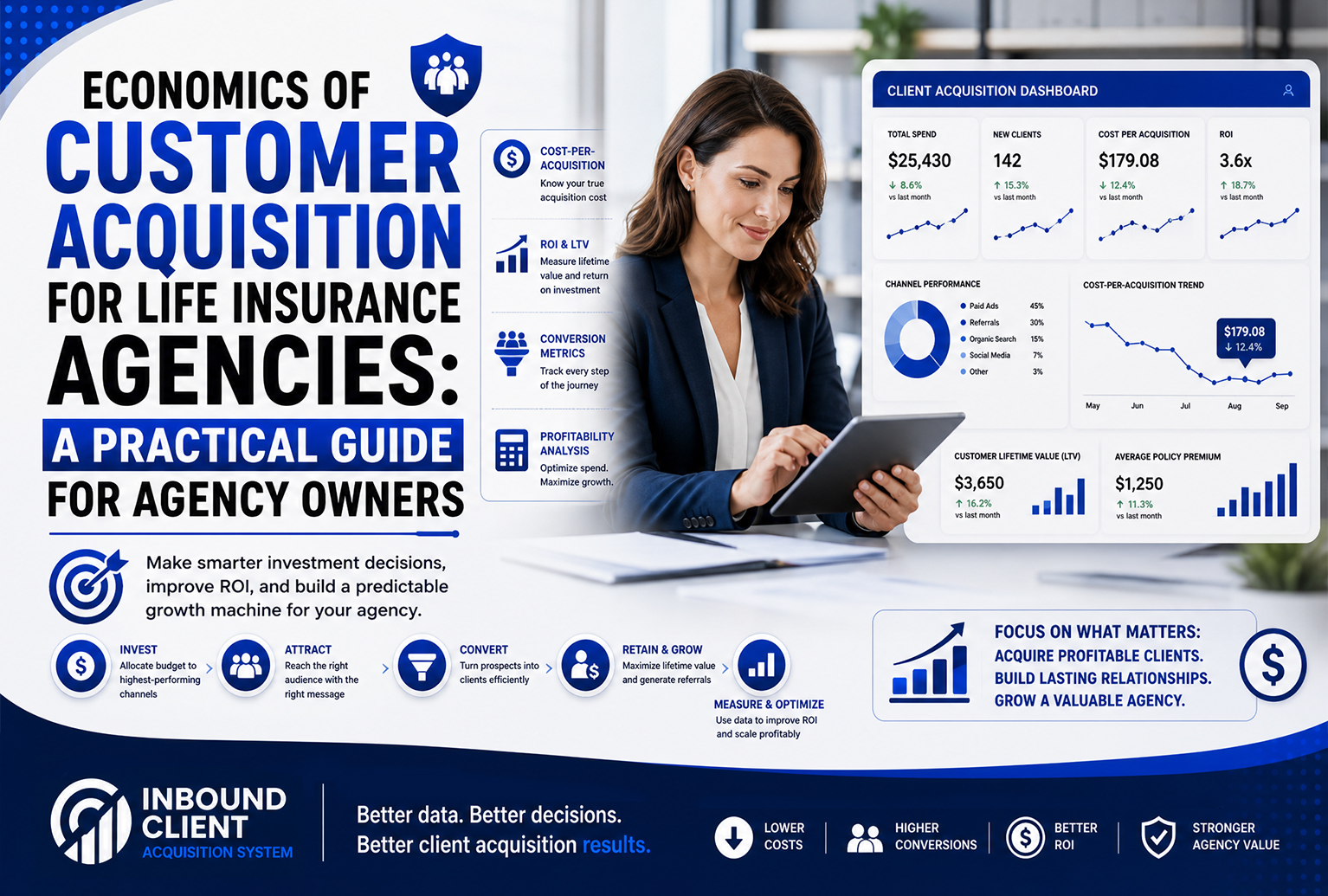
For life insurance agency owners, growth is not simply about getting more leads. It is about understanding what each new customer costs, how many leads become appointments, how many appointments become policies, and ultimately how much revenue each acquisition produces.That is the economics of customer acquisition.
Many life insurance agents focus heavily on the price of a lead. A lead costs $20, $30, or $50, and the decision often comes down to whether that number feels expensive. But the real question is not, “How much does this lead cost?” The better question is, “How much does it cost me to acquire a paying client?” That difference can completely change how you evaluate your marketing.
What Customer Acquisition Cost Really Means
Customer Acquisition Cost, commonly called CAC, is the total amount you spend to acquire a new customer.
For a life insurance agency, that cost can include advertising, lead generation, marketing software, sales tools, follow up systems, appointment setting, and the time your agents spend working prospects.
A simple formula is:
Customer Acquisition Cost = Total Acquisition Costs ÷ Number of New Customers
For example, imagine an agency spends $3,000 on marketing in a month and generates 10 new clients.
The customer acquisition cost is $300 per client.
That number is much more useful than simply knowing how much the agency paid for each lead.
If your average client generates significantly more value than $300, the acquisition model may be profitable. If the lifetime value of that customer is lower than your acquisition cost, the agency has a problem even if the lead prices look inexpensive.
Speed Has an Economic Value
One of the most overlooked parts of customer acquisition economics is speed.
Life insurance prospects can be highly responsive when they first request information. Waiting hours or days to respond can mean losing the opportunity to another agent or losing the prospect's interest altogether. An effective inbound system can shorten that gap through immediate lead delivery and automated follow up.
The Inbound Client Acquisition System is designed around this principle. When a prospect requests information, the system activates follow up and delivers the lead quickly, allowing the agent to respond while interest is still high.
The economic benefit is not simply convenience. Better response speed can create more conversations, more appointments, and potentially more sales from the same advertising investment.
Lead Ownership Changes the Long Term Economics
There is another important consideration for agency owners: ownership. When an agency continually purchases leads from outside vendors, it can become dependent on someone else's lead supply, pricing, availability, and distribution model.
That creates an ongoing acquisition expense without necessarily creating a long term marketing asset. An owned inbound lead generation system takes a different approach. Instead of simply purchasing leads, the agency builds a process around generating its own demand through advertising, landing pages, automation, follow up, and appointment scheduling.
The goal is to create a repeatable customer acquisition engine that the agency can operate and control. This does not mean advertising becomes free. It means the agency is investing in a system and process rather than depending entirely on a vendor for individual leads.
Build a Predictable Acquisition Model
The strongest life insurance agencies do not want to wonder where their next prospect will come from. They want a measurable system.
That means knowing how much is being spent, how many prospects are generated, how quickly they are contacted, how many appointments are booked, how many appointments are completed, and how many clients are ultimately acquired.
Once those numbers are visible, agency owners can make smarter decisions about advertising budgets and sales capacity.
For example, if spending $5,000 consistently produces 15 new clients, the agency has a baseline acquisition model. The next question becomes whether increasing the investment can produce additional profitable clients without causing lead quality, follow up, or sales performance to decline.
That is how customer acquisition becomes a business strategy rather than a monthly marketing expense.
The Bottom Line for Life Insurance Agency Owners
The economics of customer acquisition comes down to one simple principle: stop evaluating marketing based only on what a lead costs. Evaluate what it costs to create a customer.
Look at the entire journey from advertisement to inquiry, inquiry to appointment, appointment to application, and application to placed policy. Measure the numbers, improve the weak points, and build a system that can operate consistently.
For life insurance agents who want greater control over their lead generation, an inbound approach can provide a structured alternative to constantly purchasing shared, recycled, or redistributed leads.
The goal is not simply to generate more activity. It is to build a customer acquisition system that produces measurable opportunities, supports fast follow up, and gives the agency greater control over its future.
Frequently Asked Questions
What is a good Customer Acquisition Cost for a life insurance agency?
There is no universal number that works for every agency. A reasonable CAC depends on commission structure, product type, persistence, customer lifetime value, lead quality, and sales performance. The important goal is to maintain a profitable relationship between acquisition cost and customer value.
Should life insurance agencies focus on cheap leads?
Not necessarily. Cheap leads can become expensive customers if they require excessive follow up or produce very few appointments and sales. Agency owners should evaluate lead quality, conversion rates, acquisition cost, and customer value together.
How can life insurance agents reduce customer acquisition costs?
Agents can improve acquisition economics by targeting higher intent prospects, responding quickly, improving their landing pages, automating follow up, tracking conversion rates, and continuously improving their sales process. Better conversion can reduce the effective cost of acquiring each customer without simply trying to find cheaper leads.
Why is lead ownership important for life insurance agencies?
Lead ownership gives an agency greater control over its marketing data, campaigns, follow up, and pipeline. Instead of relying entirely on purchased leads, an agency can build an inbound system designed to generate and manage its own opportunities over time.