
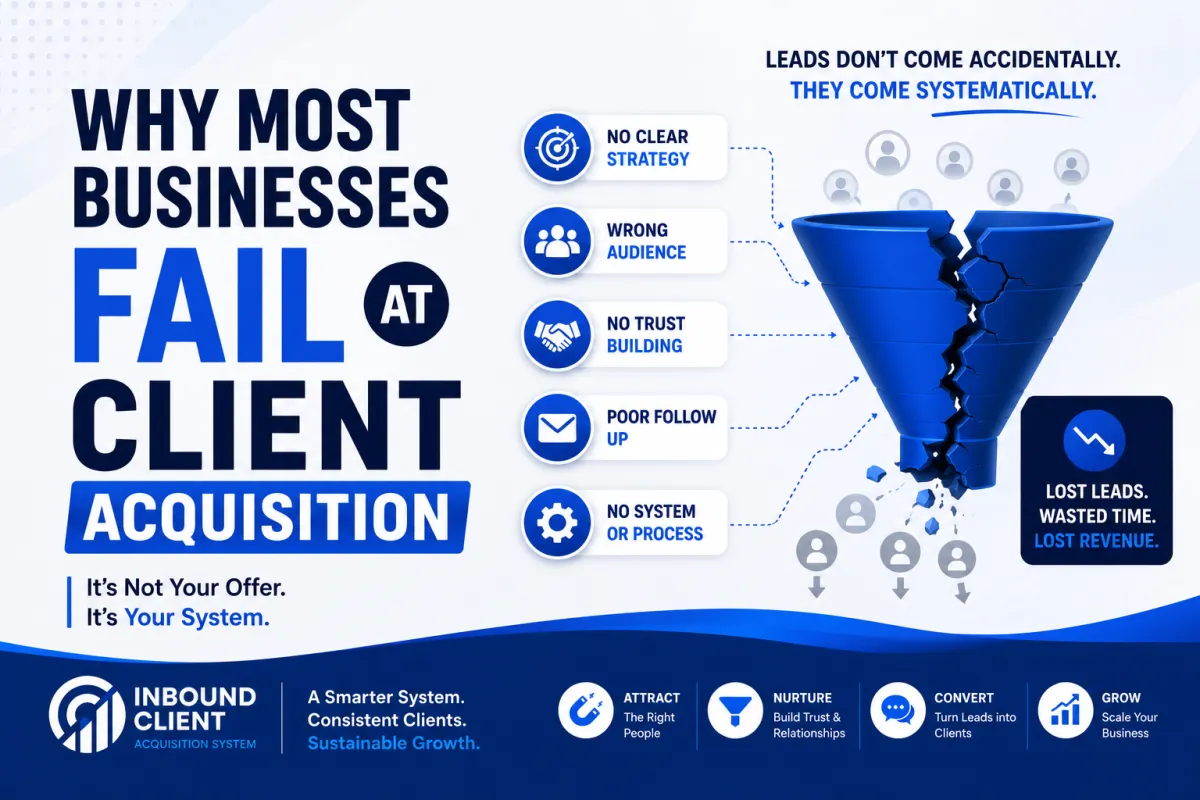
Why Most Businesses Fail at Client Acquisition
Client acquisition is one of the biggest challenges in the B2B world. Every business wants a consistent flow of qualified leads, but many struggle to turn their marketing efforts into long term clients. Some invest heavily in advertising, while others spend countless hours on cold outreach. Despite these efforts, growth often remains slow and unpredictable.
The reality is that client acquisition is not about finding more people to contact. It is about creating a process that attracts the right prospects, builds trust, and converts interest into business relationships. Companies that overlook this process often waste time, money, and valuable opportunities.
Understanding why businesses fail at client acquisition is the first step toward building a strategy that delivers sustainable results.
They Focus on Selling Instead of Solving Problems
One of the most common mistakes businesses make is leading every conversation with their products or services. Prospects are rarely interested in hearing about features before they understand how those features solve their specific challenges.
B2B buyers are looking for partners who understand their industry, goals, and pain points. When businesses position themselves as problem solvers instead of salespeople, they naturally create stronger connections.
Successful client acquisition begins with understanding customer needs and demonstrating real value rather than delivering a sales pitch.
They Target Everyone Instead of the Right Audience
Many companies believe reaching more people will generate more clients. In reality, broad targeting often leads to poor quality leads and lower conversion rates.
A business that clearly defines its ideal customer profile can create messaging that resonates with decision makers. Knowing factors such as industry, company size, business challenges, and purchasing behavior helps marketing and sales teams focus on prospects who are most likely to convert.
Quality always outperforms quantity when it comes to B2B client acquisition.
Weak Online Presence Damages Credibility
Before responding to an email or scheduling a meeting, most B2B buyers research a company online. They visit websites, read reviews, explore case studies, and evaluate expertise.
If a business has an outdated website, inconsistent branding, or limited educational content, potential clients may question its credibility.
A strong online presence should clearly communicate what the business offers, who it helps, and why it stands out from competitors. Publishing valuable content also positions a company as an authority within its industry.
Inconsistent Lead Generation
Many businesses only focus on generating leads when sales begin to slow down. This reactive approach creates unpredictable revenue and unnecessary pressure on sales teams.
Client acquisition should be an ongoing process supported by multiple channels. Content marketing, email campaigns, search engine optimization, referral programs, and networking should work together to maintain a steady flow of qualified prospects.
Consistency creates momentum, while inconsistency creates uncertainty.
Poor Follow Up Loses Valuable Opportunities
Generating a lead is only the beginning of the customer journey. Many businesses fail because they either follow up too late or stop after one or two attempts.
B2B purchasing decisions often involve multiple stakeholders and longer buying cycles. Prospects may require several conversations before making a decision.
Timely communication, personalized follow ups, and consistent engagement help businesses remain top of mind throughout the decision making process.
Lack of Trust and Authority
Trust is one of the most important factors in B2B buying decisions. Companies are making significant investments, and they want confidence that they are choosing the right partner.
Businesses that fail to showcase expertise often struggle to win new clients. Sharing case studies, client success stories, industry insights, and practical advice demonstrates experience and builds confidence among potential buyers.
People buy from businesses they trust, especially when the investment carries financial or operational risk.
Ignoring Data and Performance Metrics
Many businesses continue using the same client acquisition strategies without measuring results. This makes it difficult to identify what is working and what needs improvement.
Tracking key performance indicators such as website traffic, lead conversion rates, email response rates, customer acquisition cost, and sales cycle length provides valuable insights.
Data driven decisions help businesses optimize marketing campaigns, improve sales performance, and allocate resources more effectively.
Misalignment Between Marketing and Sales
Marketing generates leads while sales converts them into clients. When these teams operate independently, businesses often lose opportunities.
Marketing may attract prospects who do not match the ideal customer profile, while sales teams may lack the information needed to continue meaningful conversations.
Regular communication, shared goals, and aligned strategies ensure that both teams work toward the same objective of acquiring high quality clients.
No Clear Value Proposition
A business cannot expect prospects to choose its services if it cannot clearly explain why it is different.
Many companies use generic messaging that sounds similar to every competitor in the market. Statements about quality, innovation, or excellent customer service are no longer enough because nearly every business claims the same advantages.
A strong value proposition explains the unique outcomes clients can expect, the specific problems the business solves, and the measurable results it delivers.
Clarity helps prospects make confident purchasing decisions.
Building a Better Client Acquisition Strategy
Businesses that consistently attract high quality clients rarely rely on luck. They build systems that combine research, strategic marketing, relationship building, and continuous improvement.
An effective B2B client acquisition strategy starts with understanding the target audience, creating valuable content, optimizing the customer journey, and nurturing leads throughout the sales process.
Success also depends on regularly reviewing performance data, refining messaging, and adapting to changing market conditions. Companies that embrace continuous improvement are better positioned to maintain long term growth and competitive advantage.
Conclusion
Most businesses do not fail at client acquisition because of a lack of effort. They fail because they focus on the wrong activities, target the wrong audience, or overlook the importance of trust and consistency.
A successful client acquisition strategy requires more than generating leads. It requires understanding customer needs, delivering value, building credibility, and maintaining meaningful relationships throughout the buying journey.
Businesses that invest in these fundamentals create stronger pipelines, improve conversion rates, and develop lasting partnerships that support sustainable B2B growth.
Frequently Asked Questions
What is client acquisition in B2B?
Client acquisition in B2B is the process of attracting, engaging, and converting other businesses into paying clients through marketing, sales, and relationship building strategies.
Why do businesses struggle to acquire new clients?
Businesses often struggle because they target the wrong audience, lack a clear value proposition, have inconsistent lead generation efforts, or fail to build trust with potential clients.
How can SEO improve client acquisition?
SEO helps businesses attract qualified prospects by improving their visibility in search engine results. High quality content that answers customer questions can generate organic traffic and increase lead generation over time.
What is the most important factor in successful B2B client acquisition?
The most important factor is understanding your ideal customer and consistently providing value throughout the buying journey. Businesses that solve real problems and build trust are more likely to convert prospects into long term clients.